CLICK HERE for AVAILABLE: Havanese Puppies for Sale!
About Havanese:
Havanese are gentle, easy-going, compliant and cheerful little dogs, who were
bred for the sole purpose of being companions to people. They are very intelligent
and were once used as circus performers. As such, Havanese delight
in doing little tricks in exchange for affection and treats. They generally
live long healthy lives. They are not aggressive toward other dogs; quite
the opposite, they thrive with plenty of doggie socializing. Havanese especially
love other Havanese. Owners are known to throw "Havanese parties" wherein
many Havanese become instant friends. Havanese are outgoing and at the same
time somewhat submissive. They
bond to the entire family and love to be with their people. They are the ultimate
little dog in gentleness and devotion.
Also see: Havanese Health
History
and Origin of the Havanese.
 Although fairly new to the AKC, the Havanese is quite an old breed. Its
history is fascinating and important to defining the breed, as it is unique
in many respects. Although fairly new to the AKC, the Havanese is quite an old breed. Its
history is fascinating and important to defining the breed, as it is unique
in many respects.
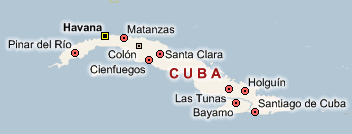
The name "Havanese" comes from the breed's place of origin: Havana,
Cuba. However, throughout the centuries, the Havanese has had many names:
Blanquito Cubano, Bichon Habanero, Bichon Havanais, Bichon of Cuba, White
Cuban, Blanquito de la Habana, Havana Silk Dog, and Spanish Silk Poodle, to
mention a few. Yet, it is one distinct breed originally developed in Cuba to
become the favored dog of aristocratic 'sugar' barons.

The
Havanese is the "National Dog of Cuba" and
Cuba's only native breed. Over time,
the Havanese was exported to other countries typically as a gift to nobility.
Making its debut in England somewhere in the 18th century,
two were owned by the Queen of England and one by Charles Dickens. The statue
on the right is a Meissen porcelain; Germany; ca.1770.
First: Small White Dogs.
Dating as far back as the time period of 300-600 B.C., images of small
white dogs appear on artifacts discovered in Faryum, Egypt.
These dogs are thought by many historians to be the "Blanquito",
progenitor of all modern small breed dogs and named for its white color.
The Blanquito indigenous to Malta were called "Maltese". However,
those were sturdier than modern Maltese, with upright ears, a coarse coat,
and appearing in a variety of colors. The name "Blanquito" referred
to the white ones, and eventually were well distributed throughout Europe
- mentioned in Latin by Aristotle (384 BC – 322 BC). The Romans selected
the Blanquito for its pure white coat, and Roman Emperor Claudius owned
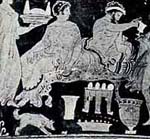
several of them (AD 41 - AD 54). Images of these dogs were a common theme
for elaborately decorated Roman vases (example below).
Then: Small Soft-Coated Dogs.
Over the ages, Blanquito appeared with increasingly softer
coats, developing both silky and curly (cotton-like) varieties.
The term "Barbichon" - and its abbreviated form, "Bichon" -
comes from the French word for "soft-coated".
The modern Bichon is thought to have developed from a Spanish
curly-coated Blanquito, called the "Tenerife," named
after its island of origin.
Many breeds gradually evolved from the original Bichon-Blanquitos,
each as unique as its homeland. While the French Bichon
Frisé is possibly the most well known, the Bichon group currently
includes the Bolognese, Coton De Tulear, Havanese, Löwchen, Maltese,
and Russian Tsvetnaya Bolonka. Each breed within the Bichon group
developed its own look and personality in association with its
native geographic region.
 Individual
breeds
within the Bichon group vary a bit in appearance, but all have
tails curled over their back, a coat that is hair rather than
fur (non-shedding),
drop ears, pointed though slightly shortened snouts, and large
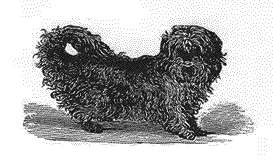
dark eyes. Black Bichons, like the one depicted in the engraving
to the right, were considered undesirable and not permitted in
European show rings until near the end of the 20th century. Today's
Havanese coat comes in a wide variety of colors, including black,
all equally acceptable in the show ring.
Finally: Small Cuban Dogs.
During the "Age of Exploration" - from the early
15th century into the early 17th century -
Europeans began to explore the world by ocean. In November of 1492, the
flag of Spain was first raised over Cuba by Christopher Columbus.
In the ten years following, colonization was begun on the island
by Spain who owned it for the better part of the next four hundred
years. Bichon-Blanquito dogs were taken on board ships during
these extended voyages to fend off rodents and to keep the sailors
entertained. They were then offered as gifts upon arrival to
gain the favor and trust of the receiving aristocratic class.
Only the most hardy little dogs could survive the long, arduous
journey and only the most affectionate and responsive dogs could
achieve aristocratic acceptance. Any dog prone to rude behavior
would certainly not have fulfilled (or survived) its purpose.

These dogs, as rare and cherished gifts, became increasingly popular with
the Cuban elite. The "Blanquito Cubano", as it was known, gradually
evolved into a smaller version of its ancestors.
With its diminutive size, alert expression and affectionate nature, the
sweet, silky dogs fit perfectly with emerging Cuban tastes that
emphasized white clothing, soft food, indulgent manners, and appealing
good looks. Because the breed was developed in Cuba by aristocratic owners
of vast sugar plantations, litters were never for commercial sale, but
were instead planned for the express purpose of giving to intimate friends
and family members.
But, then... Near Extinction.
Cuba's communist revolution from 1958-1960 almost decimated
the breed. Many wealthy people escaped the island in a huge hurry to save
their own lives - with the intent of returning after the violence had
passed. Unfortunately, the majority of these people were unable to return
to their homes and many dogs were left to fend for themselves, either starving
to death or wandering the streets looking for scraps. As a result, the Cuban
Havanese were nearly wiped out - along with their pedigrees. Only three families
that fled Cuba successfully took their Havanese with them: the Perez and
Fantasio families that moved to the U.S., and Senior Barba in Costa Rica.
 And
now: American Havanese. And
now: American Havanese.
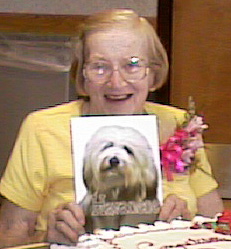
During the early 1970's in the United States,
Dorothy Goodale (pictured right) and her husband, Burt,
made it their mission to rekindle the breed. Their goal was to find and
purchase as many purebred Havanese as possible. After years investigating
elusive references to these little dogs, finally they chanced upon an advertisement
for six pedigreed Havanese, representing the two unrelated bloodlines of
the Perez and
Fantasio families.
Mrs. Goodale continued to offer to purchase Havanese in Latin American
newspapers and received only one other response: Senior Barber in Costa
Rica agreed to sell five Havanese to the Goodales. As a result, by 1974,
eleven dogs, representing three unrelated bloodlines, established the Goodale's
Havanese fledgling breeding program. In 1979, she founded the Havanese
Club of America with a small group of newly-involved breeders and supporters,
and an official registry was established.
Eventually, through careful and selective breeding, the number of
quality Havanese became large enough to petition the United
Kennel Club for breed registration in 1980. In 1996, the first Havanese
entered an AKC show ring, and was accepted for as a
member of the Toy Group on January 1, 1999. The International
Federation recently reinstated Cuba's patrimony of its only native breed,
officially declaring the Havanese to be "The National Dog of Cuba".
It is estimated that 4,000 Havanese are owned in the United States today
and another 7,000 worldwide.
Read about
the Havanese Health and Personality
This website is offered for informative purposes only and does not form
a contract of any kind. As such, any information contained herein
is subject to change without notice.
Copyright
Jane Falkenstein, All rights reserved.
|